Fixed, folding and thumbhole forms
The fixed stock is the baseline form for many AK and AKM rifles. Its profile varies with national production, receiver attachment and material. Underfolding stocks hinge below the rear of the receiver, allowing metal struts to fold along the sides. Sidefolding designs pivot to one side and appear as metal frames, stamped forms or polymer bodies depending on the pattern.
Thumbhole stocks combine the butt and grip into a single continuous shape. They are especially visible on U.S.-market rifles whose configurations reflected the import environment of their period. That shape is an important historical clue, but furniture can be changed; it does not prove the complete original configuration of an individual rifle.
Wood, laminate and moulded materials
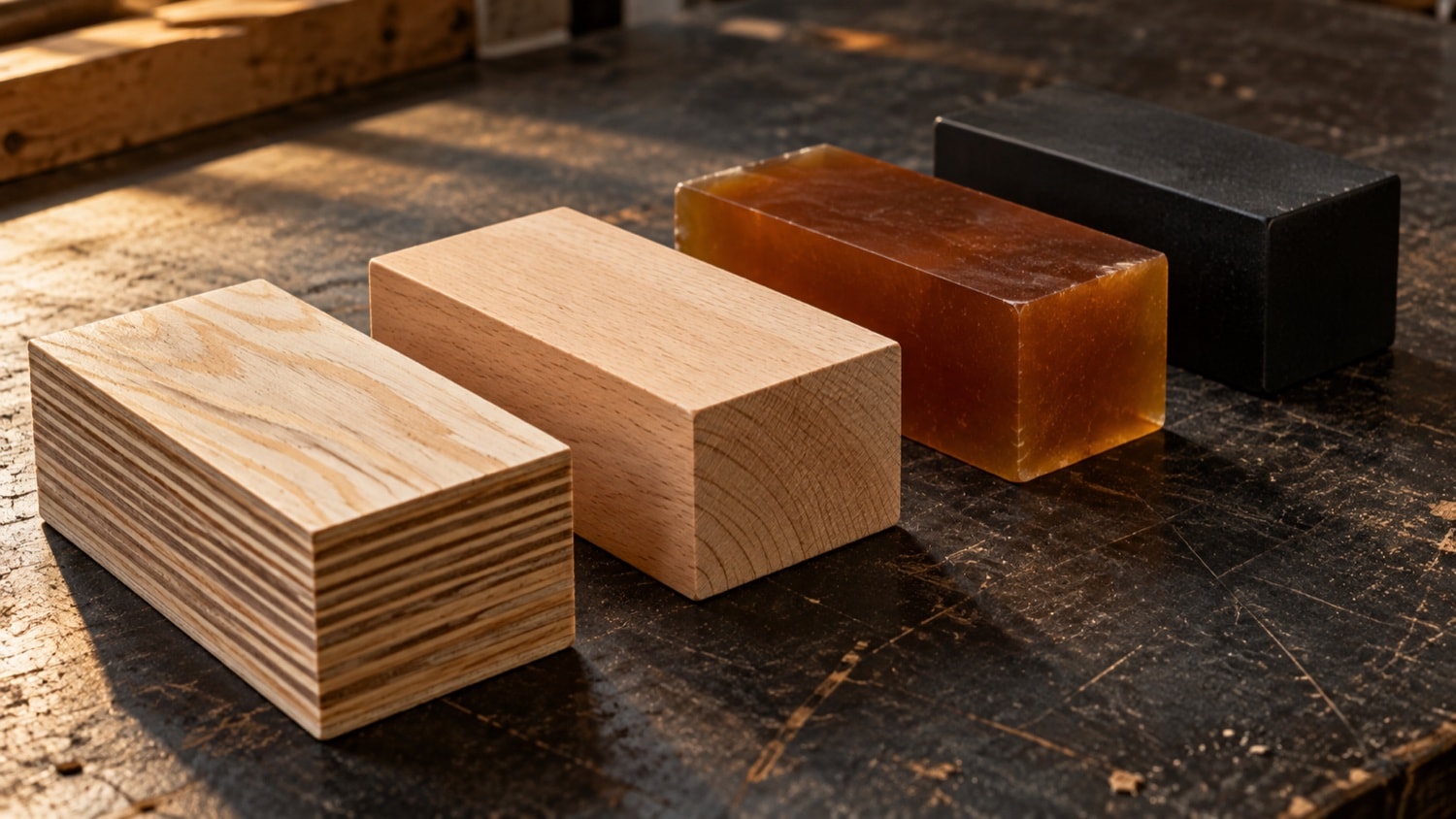
Early furniture commonly used solid hardwood. Grain, colour and finish vary, so a broad “blond” or “dark” description is not a reliable country identification. Laminated wood bonds thin layers with adhesive, producing visible stripes at edges and end grain. It uses wood efficiently and can be formed into stable, repeatable shapes.
Reddish or amber pistol grips and handguards are often called bakelite in casual speech, though fibre-reinforced phenolic composite is frequently more accurate. Later polymers range from smooth early mouldings to reinforced modern forms. Colour remains secondary evidence; mould marks, shape and attachment geometry are more informative.
Upper and lower handguards
The lower handguard surrounds the forward portion of the rifle beneath the gas system and provides a primary contact surface. The upper handguard wraps the gas-tube area. Wood examples may be smooth or relieved; polymer examples may use ribs or vents as part of the moulded shape. Support-role variants can carry distinctive lower-handguard and stock profiles.
Pistol grips also vary in angle, width, texture and attachment details. Those changes influence how the rifle meets the hand without changing the fundamental operating system. The range ergonomics page looks at contact pressure and fatigue without offering shooting coaching.
Receiver geometry controls attachment
Milled and stamped receivers commonly use different rear attachment geometry. Stamped patterns can also differ in rear-trunnion shape, tang arrangement and receiver cut. A label that says only “AK stock” is therefore incomplete as technical documentation. The same principle applies to handguard retainers and gas-tube dimensions.
This reference describes those families but provides no installation, fitting, cutting or conversion procedure. Altering furniture can affect handling, historical integrity and legal classification. Identification should begin with the intact receiver and exact model, using the receiver guide as the first branch.