The front lug and rear catch
Many AK-pattern box magazines use a front lug and a rear locking tab. The receiver and magazine form a pivoting, commonly called rock-and-lock, interface. That description identifies the geometry; it does not mean every curved AK-pattern magazine fits every rifle. Chambering, national dimensions, single-stack or double-stack form, receiver configuration and model-specific tolerances all matter.
Cartridge shape influences curvature. The tapered 7.62×39mm case produces the pronounced curve associated with its box magazines. The slimmer 5.45×39mm stack produces a different profile. Magazines for 5.56×45mm variants form another group. Curvature is useful supporting evidence, but the marked chambering and exact magazine pattern should control identification.
Steel, phenolic composite and polymer
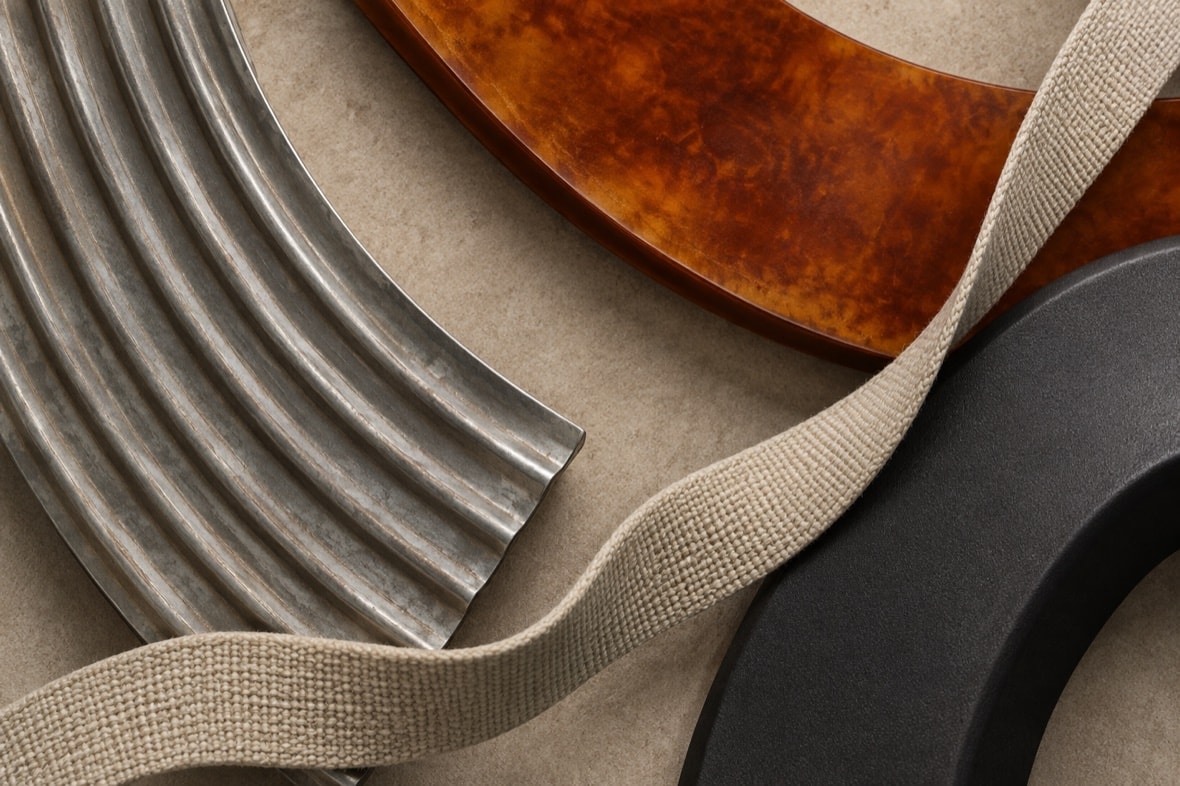
Pressed-steel bodies are the classic early material. Reinforcing ribs add stiffness without requiring a uniformly thick wall, while welded seams and attached locking features complete the shell. Surface finishes vary by country and era. Wear on high points may reveal the underlying metal, but finish colour alone is not a reliable national identifier.
Collectors often use “bakelite” as a catch-all for orange or brown composite magazines. Many such bodies are more precisely described as fibre-reinforced phenolic composite. Later polymer bodies appear in several colours and reinforcement patterns. Material terminology should describe what is visible rather than imply a manufacturer or performance ranking.
Capacity as a historical clue
Box magazines appear in a range of capacities. Five- and ten-round forms are associated with sporting or restricted-market configurations; twenty-round bodies appear in compact and national patterns; thirty-round magazines are the standard visual reference for rifle use; and forty-round examples are closely associated with support-weapon roles. Drum magazines form a separate mechanical category, with common historical examples holding seventy-five rounds.
These figures identify established types, not a recommendation. Laws and range rules vary, and a historical capacity does not establish what may be possessed or used in a particular place. This page provides no capacity workaround, alteration method or fitting instruction.
Followers, ribs and markings
The follower supports the cartridge stack and translates spring pressure into upward movement. Its shape works with the feed-lip geometry and cartridge. Floorplate stamps, mould numbers, arsenal symbols, reinforcing ribs and witness holes can help date or classify a magazine, but isolated markings are easily misread. Documentation should record the whole object: both sides, spine, floorplate, follower and locking surfaces.
Drums, chargers and pouches
Drums store cartridges in a circular body rather than a conventional curved box. Their internal arrangements vary and should be treated as distinct designs. Stripper clips or chargers are separate loading aids used with an appropriate guide; they are not detachable magazines. Canvas and synthetic pouches often reveal the number and style of magazines a field kit was intended to carry.
For cartridge context, see 7.62×39mm and 5.45×39mm. For slings, oilers and cleaning-kit containers, see field accessories.